The swipe file

100 Reasons Buyers Say No

A deal you should have won just died. Here's the exact reason it happened, and what to do about it. Flag every reason that stings and you'll walk away with your own fix list.

Get the free Playbook.
Where should we send it? You'll also get the fixes behind the reasons you flag.

No spam. Unsubscribe anytime. Privacy Policy.

100reasons
11parts
1fix for each
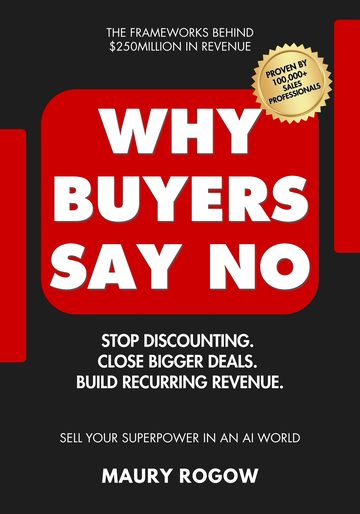
Why Buyers Say No by Maury Rogow
01
Part One

They can't tell you apart

The sameness tax, and who actually pays it.
Reasons 1 to 11
01/ 100

Buyers don't say no to your product.They say no to your story.

The product rarely loses. The words around it do. When the story is fuzzy, the buyer can't build a case for you in their own head, so they pass. Fix the story and the exact same product starts closing.

02/ 100

When they can't tell you apart,they don't compare you. They price-shop you.

A real comparison needs two things you can actually tell apart. When every vendor on the shortlist sounds the same, there is nothing left to weigh but the number at the bottom. So they pick the cheapest and call it a decision.

In the bookMake one thing about you impossible to blur. That is what the STUFF framework is built for.
03/ 100

Sameness is a tax.You pay it on every deal until you fix the words.

Here is the tax in four words: same words, same box, same price. Describe yourself the way your competitors describe themselves and the buyer files you in the same box and pays the going rate. Different words are the only thing that moves you out of it.

04/ 100

Nobody cares how hard you work.They care about the result.

Effort is invisible, and honestly a little boring to a buyer. They are not buying your late nights; they are buying what changes for them. I learned this shoveling coal into a furnace at 2am in a Pittsburgh basement. Nobody clapped for the shoveling. They just appreciated the heat.

05/ 100

Your competitor just closed your dream client.Weaker product. They told it better.

This happens every day, and it is the most fixable loss there is. Same market, same solution, and the deal went to whoever made the buyer feel something and understand it faster. Story is the edge, not spec.

06/ 100

Ask a buyer to describe their optionsand they describe one company. Yours included.

Forrester calls it the sea of sameness and puts it at 71%. Seven in ten prospects already believe every vendor in your category is basically the same. That is the hole you are climbing out of before you say a word.

In the bookThe entire first act is about climbing out of that box.
07/ 100

AI didn't level the field.It flooded it.

Open your inbox and scroll. Ten cold emails, one voice, all polished, all forgettable. When the machine lets everyone sound competent, sounding like everyone else makes you invisible. Invisible companies quietly die.

08/ 100

More features won't save you.Neither will more content.

Volume is what you reach for when you have nothing distinct to say. You cannot out-produce sameness, you can only out-position it. One sharp idea beats a hundred generic assets.

09/ 100

Being different isn't discovered.It's designed.

This is the good news. You do not have to wait to stumble onto what makes you different. You build it on purpose, with intent, using structure. Which means anyone willing to do the work can learn it.

10/ 100

Don't race in their lane.Build your own.

Every competitor is running the same track on the same terms, which is exactly why the buyer can't tell them apart. Step off it. Reframe the category so people see you as a different kind of thing, not a slightly better version of the same thing. When you own the frame, there is nobody left in it to compare you to.

In the bookPick the one thing you do differently and build a whole lane around it. Own the frame and you own the choice.
Unlocked. All 100 are yours.Your free Deal Playbook is ready too.
Get the Playbook →
11/ 100

Unclear makes you invisible.Forgettable makes you replaceable.

These are the two ways a weak story fails. Unclear and they never engage. Forgettable and they engage, then wander off to someone cheaper. The rest of this book is how you avoid both.

02
Part Two

They didn't feel anything

Five emotions. Most pitches use zero.
Reasons 12 to 21
12/ 100

Logic justifies the purchase.Emotion makes it.

People decide with feeling, then reach for reasons to defend the decision. An all-logic pitch hands them the defense with nothing to defend. Zig Ziglar called selling a transfer of feelings, and he meant it literally.

13/ 100

STUFF.Sizzling, Touching, Unique, Funny, Fear.

Every story that actually moves a buyer hits one or two of these five, and hits them hard. Across all your stories, use all five. Most business pitches hit zero, which is exactly why they slide off.

In the bookSTUFF is the emotional checklist. The full teardown is in the book.
14/ 100

Sizzling isn't sexy.It's aspiration.

Stop selling the 47 features and start selling the after. Sell the Tuesday where Rosa leaves at five and nobody emails her. Show her the version of herself she wants to be, then make it feel close enough to reach.

15/ 100

One customer in tears at 2ambeats ten thousand satisfied since 2005.

Aggregate numbers are forgettable; one human moment is not. Tell a single person's story with specifics and the buyer casts themselves in it. Statistics prove. Stories persuade.

16/ 100

Unique means you ziggedwhile everyone else zagged.

Look at what every competitor in your category does, then deliberately do the opposite. Razor ads had athletes in slow motion. Dollar Shave Club had a guy swearing his way through a warehouse, and ate the category.

17/ 100

Funny isn't jokes.It's the nod of recognition.

You are not going for a laugh, you are going for the smile that says “that is exactly my Monday.” Describe a buyer's world back to them accurately and they trust you faster. Recognition is the cheapest trust you will ever buy.

18/ 100

Aspiration alone doesn't close.Show the cost of waiting.

People need to feel what standing still costs them. Fear here is not terror, it is the quiet math of what another quarter of the same problem adds up to. Every pitch needs that cost made visible.

19/ 100

Count the emotions on your homepage.Zero or one?

Most “professional” sites are emotionally flat, which reads as forgettable, not credible. Read yours out loud right now and mark where anyone would feel anything. It takes ninety seconds and it will ruin your afternoon.

20/ 100

Match the emotion to the stakes.The wrong tone ends brands.

Humor in a moment that demanded care has cost companies years and millions. Emotion is a power tool: right one, right moment, or the apology tour costs more than the campaign ever made.

21/ 100

Even PhDs want to smile.

For a biotech I'll call MicroLife, we turned chromatography molecules into characters with personalities and bad days. Their very serious scientist CEO stood on stage poking fun at himself with our cartoons. They are still known as the fun one in their category.

In the bookThe full case study, and how to find your own version, is inside.
03
Part Three

They got lost

Right words, wrong order, dead deal.
Reasons 22 to 33
22/ 100

Order mattersmore than content.

You can have every right word in the wrong sequence and still lose the room. Sequence decides whether a buyer leans in or checks out before you reach the good part. Get it right and average material outperforms brilliant material told backwards.

23/ 100

EPIC.Empathy, Problem, Impact, Change.

Four moves, in order, and that is the whole pitch. Empathy earns the right to speak, Problem proves you understand, Impact shows the cost of nothing, Change is the one clear step forward. Most people only ever use it to win the deal. It also builds the campaign after.

In the bookEPIC in full, with examples, is in the book.
24/ 100

Empathy first.Always.

“Let me tell you about our product” is where trust goes to die. Their brain is not ready and you have not earned the airtime yet. Open on their world, not yours.

25/ 100

Buyers don't trust youuntil you describe their problem better than they can.

Diagnose before you prescribe. Name Rosa's pain more precisely than she has ever heard it and she thinks, this one actually gets it. That is the moment the sale really starts.

26/ 100

Impact is the costof doing nothing.

Not what your product does. What their problem charges them every month they wait. Put a number and a feeling on the status quo. Skip it and you have a lovely presentation with no reason on earth to act.

27/ 100

Give them one next step.Not five options.

Choice feels generous and lands as paralysis. “Book a demo, download the whitepaper, join the webinar, or call us” is four ways to do nothing. One clear next move beats a menu every time.

28/ 100

STAKES.Scene, Trouble, At Risk, Key Move, Execute, Score.

This is how you open with data and keep the room awake. Same numbers, different order: one version gets checked phones, the other gets a budget. It turns a dry client anecdote into something a room will sit still for.

In the bookSTAKES, step by step, is in the book.
29/ 100

If nothing's at risk, it isn't a story.It's a status update.

Somebody has to want something badly and something big has to stand in the way. No tension, no attention. Stakes are what make a listener need to know what happens next.

30/ 100

The best idea doesn't win.The best-told idea wins.

I have watched brilliant concepts die and mediocre ones get greenlit purely on framing. Telling is not decoration, it is the deciding variable. And sequence is free, so you are leaving the cheapest edge on the table.

31/ 100

Structure beats creativity.Every time.

Creativity is what you pour into the structure, not a replacement for it. A wild idea with no spine collapses in the room. Build the frame first, then get clever inside it.

32/ 100

This isn't manipulation.It's respect for how people decide.

You are not tricking anyone, you are organizing your case the way a human brain actually takes information in. Making yes easy to understand and act on is a service, not a con. Confusion is the disrespectful option.

33/ 100

You don't write the pitch that works.You rewrite it seven times.

The version that lands is the one you have tested on real humans and cut down. Read it aloud, time it, record it on your phone. If you would not say it at dinner, cut it.

04
Part Four

They never saw the difference

Everything you call a price objection.
Reasons 34 to 38
34/ 100

Price is never the reason.It's the reason they give you.

“Too expensive” is what a buyer says when they could not find a difference worth paying for. If two things look identical, the cheaper one is not a bargain, it is the only rational choice. So the real problem is upstream: they never saw the difference.

35/ 100

“You're too expensive”is the short version.

The long version is: show me what I get here that I can't get down the street for less. Answer that second sentence and the price objection dissolves. Argue with the first and you are negotiating against yourself.

36/ 100

Discounting is a confession.

The moment you drop the number, you have told the buyer your first one was decoration. That teaches them to push, and it quietly says your value was soft. Hold the number and change the story instead. It works more often than anyone believes.

37/ 100

Value isn't what you do.It's what breaks when you're gone.

Most sellers can describe their service. Almost none can describe the hole it leaves. Name the hole, the thing that falls apart without you, and price stops being the conversation.

In the bookThis reframing is core to the CLOSER close.
38/ 100

If you can't finish this line,you'll lose on price.

“The only people who do this the way we do are ___.” If the best you have is “we care more” or “better service,” that blank is empty and your buyer already knows it. Fill it with something true and specific and you have built your whole differentiator.

05
Part Five

You told the wrong person

Great story, empty chair.
Reasons 39 to 45
39/ 100

The best story told to the wrong personis a rounding error.

Find out who signs before you find out who is excited. Enthusiasm is not authority, and the person who loves you most often has the smallest budget. Aim your best material at the seat that can actually say yes.

40/ 100

Your champion isn't your buyer.They're your co-writer.

Their real job is telling your story in rooms you will never enter. So your deliverable is not a pitch, it is a story simple enough for someone who does not work for you to repeat under pressure. Arm them accordingly.

41/ 100

Send the one page they can forwardwithout explaining it.

If it needs your voiceover to make sense, it is not finished. Test it: would it survive being read on a phone, in a hallway, by someone who missed the meeting? That is the bar for anything that travels without you.

42/ 100

Single-threaded deals diethe day one person changes jobs.

Every decision-maker you have not met is a “no” waiting for its turn. Get the second name, then the third. Relationships spread across a committee survive the turnover that kills solo deals.

43/ 100

Different seats,different stories.

The CFO wants the cost of doing nothing. The operator wants their Tuesday back. Same product, two scripts. Tell the operator's story to the CFO and you will lose a good deal, politely.

44/ 100

“Let me take this to the team”means an amateur now represents you.

Someone with your story half right is about to pitch it for you, in a room you are not in. Do not hand off and hope. Rehearse them, and ask out loud what they will say when someone pushes back.

45/ 100

I chased one account for three monthsand never pitched once.

I just noticed their wins out loud, again and again. Persistence without empathy is only stalking with a logo, but persistence with genuine attention is disarming. The VP finally called: not because your product is better, because we know you will not stop.

06
Part Six

They liked you and still didn't buy

What actually happens when a human is across the table.
Reasons 46 to 56
46/ 100

Slide 47.

I once watched a sales VP read slide 47 aloud while the CFO checked his phone and the CMO studied the ceiling. If your deck has a slide 47, your story ended somewhere around slide six. Length is where good pitches go to suffocate.

47/ 100

Nobody ever complaineda pitch finished early.

Trim ten percent the morning of, because adrenaline will make you talk longer than you planned. It always does. Shorter reads as confident. Overstaying reads as unsure.

48/ 100

The demo isn't the pitch.It's the proof inside it.

Leading with the demo is handing someone the receipt before the meal. First make them want the outcome, then show the mechanism. Features mean nothing until the buyer cares what they are for.

49/ 100

“What's in it for me?”Rosa asks it after every line.

Rosa, your stand-in buyer, runs that question silently the whole time you talk. Answer it as you go or she stops listening and starts planning dinner. Every claim should connect to something she gets.

50/ 100

The right questionswrite your pitch for you.

Ask six good ones, then stop talking and take notes. The story a buyer tells you across those answers is the exact story they will buy back from you. Your job is mostly to listen well enough to sell it back.

51/ 100

I did a magic trickat the end of a job interview.

I had nothing left to lose, so I stopped hiding the odd thing about me. He laughed, called his kid in, asked me to golf, then hired me. Not because I am a great magician, because I finally showed up as a person.

52/ 100

The only ROI numbers that landare the ones they say out loud.

Yours sound like marketing. Theirs sound like math. Ask the questions that get the buyer calculating their own burn rate mid-sentence. The moment the number is in their mouth, urgency flips from someday to now.

53/ 100

“What keeps you up at night” still works.Talking after it kills it.

The question is fine. The silence after is the tool. Count to five in your head and let it sit. They will fill it, and what they fill it with is your pitch.

54/ 100

Your quirksare the differentiator.

The karate trophies, the inventions that flopped, the standup sets. The stuff you edit out is the stuff they remember. Sameness is safe and forgettable, and everyone else is already taken.

55/ 100

When your prospect repeats your question to their boss,you've already won.

Most deals are decided in meetings you are never invited to. If your buyer walks in and asks the room your question, you are pitching by proxy through someone who trusts you. Arm them for exactly that moment.

56/ 100

If you can't tell it without slides,it isn't a story yet.

Try it in an elevator, try it at a bar. Slides are a crutch you rent for forty minutes and then lose. The story has to stand on its own or it does not stand.

07
Part Seven

They never watched

Story on camera, where most people fall apart.
Reasons 57 to 62
57/ 100

The camera doesn't add ten pounds.It removes ninety percent of your energy.

Whatever you are feeling, the lens shows about half of it, which is why flat becomes dead on screen. I have directed more than a thousand commercials and the note I give most is two words: again, bigger.

58/ 100

Five seconds to hook.Twenty-five to deliver.

That was the rule for a thirty-second spot, and your sales video does not get more grace than a Super Bowl ad. If the first five seconds do not earn the next twenty-five, nothing else you shot matters. Open where it hurts or where it wows.

59/ 100

Nobody watches your videoto learn about your company.

They watch to decide whether you are worth twenty more minutes of their life. So the video's only job is to make the next step feel worth it. Talk about them, not your founding year.

60/ 100

Talk to one person,not an audience.

The camera is intimate, and the people who fail on it are the ones announcing. Picture Rosa and use her name in your head. It changes your face and your voice. An audience of one always outperforms everyone.

61/ 100

If the first frame is your logo,you already lost them.

Open on the problem. The logo can wait until they care. Watch where viewers drop off and it is almost always right after the branded intro nobody asked for. Earn attention before you spend it on yourself.

62/ 100

A recorded pitch beats a live one in one way:you can cut the worst forty seconds.

Almost nobody does. Record it, then watch it once on mute and you will spot the dead forty seconds instantly. The edit is the cheapest performance upgrade you will ever get.

08
Part Eight

They never opened it

Inbox, DM, and everywhere selling now actually happens.
Reasons 63 to 68
63/ 100

Most selling is asynchronous now.Nobody trained you for it.

The pitch increasingly happens in an inbox or a DM, without you in the room. Everything you know about the first five seconds on a stage applies to the first nine words in a preview pane. The medium changed. The storytelling did not.

64/ 100

The subject line is the hook.Not a label.

It is the five-second opener of the whole message, and most people waste it on a summary. “Quick question” is what everyone sends, so it blends in and gets skipped. Earn the open or nothing else you wrote exists.

65/ 100

A cold message is an invitation,not a pitch.

One line about them, one line about the gap, one question, then stop typing. If your third message is your longest, you have stopped selling and started pleading. Short and curious beats long and needy.

66/ 100

A nurture sequence is a serial,not a newsletter.

Four emails that continue one story beat forty that keep starting over. Each one should end owing the reader something, a reason to open the next. Continuity is what turns sends into a relationship.

67/ 100

Give away the diagnosis.Charge for the cure.

The free thing should make the problem impossible to unsee. You are inside that exact machine right now, and I would rather say it plainly than have you notice later. Generosity with the diagnosis earns the right to sell the fix.

68/ 100

Automate the sending.Never automate the noticing.

The second your outreach sounds generated, you become the thing you were trying to beat. Let the machine handle volume, but keep one real human observation in every message. One true detail about their business beats a hundred merge fields.

09
Part Nine

They stalled

Interested is not the same as buying.
Reasons 69 to 81
69/ 100

The quick pitch.Pain, Path, Promised Land.

Where they are and why it hurts, the road you provide, and the better place it leads. It's the pitch for when you only have a few minutes. Got 10 to 20? That's the Unicorn Story, the full presentation.

In the bookThe quick pitch and the full Unicorn Story are both in the book.
70/ 100

The customer is the hero.You're the guide.

Get that backwards and the best deck in the world lands flat. Nobody wants to watch you be the hero of their problem. Hand them the cape and position yourself as the one who gets them through.

71/ 100

Don't sell efficiency.Sell the ten-minute meeting that used to take ninety.

Abstract benefits do not move people, specific scenes do. Sell the Monday where the kickoff takes ten minutes and the team gets back to real work. Tangible, emotional, and concrete enough to picture the room.

72/ 100

Buyers trust third-party proofover anything you say about yourself.

Forrester puts it at 86%. A customer's words carry weight yours never will, because they have nothing to gain. Your case study is worth more than your homepage.

73/ 100

The Three Why's.Why anything, why you, why now.

Miss one and the deal stalls in committee. Why change at all, why you over the alternatives, and why this has to happen now. Stalled is worse than lost, because lost at least tells you something.

In the bookThe Three Why's in full are in the book.
74/ 100

Why now is the oneeverybody skips.

It is also the only one that moves a date onto a calendar. Tie it to a real consequence with a real deadline they already have, theirs not yours. Without it, even a yes drifts forever.

75/ 100

CLOSER.The conversation where it actually has to close.

Current state, Losing proposition, Opportunity, Stories and proof, Economic impact, Recap and next steps. Six moves, in order, for the meeting where a decision gets made. It is the spine of the close, not the discovery.

In the bookCLOSER, step by step, is in the book.
76/ 100

“We already have someone”isn't a “no.”

It is a request for a reason worth the pain of switching. Nobody leaves a vendor because something better exists, they leave when staying becomes unbearable. Your job is to make the cost of staying visible.

77/ 100

Never attack the incumbent.

You are insulting the person who chose them, and now they are defending, not listening. Attack the gap that opened up after they chose instead. “That was the right call in 2021” is a sentence that has won me deals.

78/ 100

A number you can't sourcecosts more than no number at all.

One challenged stat and everything else you said is suspect. I pull unverifiable figures out of my own work, and it stings every time. Do it anyway. Credibility is worth more than the impressive claim.

79/ 100

A vague futuregets you a vague yes.

“Let's circle back” is what a vague yes sounds like. If the outcome you paint is fuzzy, the commitment will be too. Specific promises get specific answers.

80/ 100

Every objectionis a story you didn't tell.

Write it down the moment it happens, because it belongs in the next pitch. Your objection log is the best product-marketing document in the company, and almost nobody keeps one. Patterns in the “no”s tell you what to say sooner.

81/ 100

Silence isn't agreement.It's a buyer doing math you can't see.

Do not fill it and do not assume it. Ask what they are weighing, out loud, right then. That unspoken calculation is where the deal is actually being decided.
10
Part Ten

You never followed through

The gap between knowing this and doing it.
Reasons 82 to 93
82/ 100

Ask the buyer why you lost.Actually ask.

About half will tell you, and what they say is worth more than the deal was. Ask in one line with no defense attached, because the defense is what stops them answering. Their answer is free training for the next ten pitches.

83/ 100

A loss isn't a closed file.It's a nine-month lead.

The person who chose someone else will be disappointed on a schedule. Put the date in your calendar the day you lose, because nobody else will be there when it goes wrong. Timely, useful, and you are the one who understood them.

84/ 100

Write down the exact wordsthey used to say no.

Their words, not your summary, because your summary is already a defense. “Too expensive” and “not a priority” are completely different diseases with different cures. The phrasing is the diagnosis.

85/ 100

Six people, six versions of the story,six companies the buyer met.

When your team cannot tell one consistent story, the buyer trusts none of them. Consistency reads as conviction, variation reads as improvisation. Alignment inside is what the buyer feels outside.

86/ 100

The story you tell inside the buildingbecomes the one you tell outside it.

You cannot fake conviction in a room full of adults. If your own team cannot say why you are different, stop polishing the pitch and go fix that first. Belief is upstream of persuasion.

87/ 100

Blockbuster. Toys R Us. Sears.

Once the most trusted names in their categories, each told the wrong story at the wrong time and vanished. Nobody is too big to become a cautionary slide in someone else's deck. Position is never permanent.

88/ 100

A closed deal isn't the finish line.It's your next storyteller.

Your happiest customer is a case study that has not been asked yet. The referral you did not get is almost always the one you did not ask for. Follow-through is where the next three deals are hiding.

89/ 100

Audit what you're saying right now.Keep, Fix, Kill.

Most people have never once read their own pitch as a stranger would. Sort every line into three piles and be honest about which one is biggest. Do it standing up, out loud, today.

90/ 100

The 4 Ds.Discover, Design, Deliver, Diagnose.

Thirty days, then run it again. The gap between people who know this material and people who win is implementation, and it is always implementation. A simple loop you actually run beats a perfect plan you do not.

In the bookThe 4 Ds dashboard is in the book.
91/ 100

Consistency beats perfection.

Eighty percent implemented fully beats a hundred percent planned. Perfection is the enemy of done, and done is the only thing a buyer ever experiences. Ship the story, then improve it in the open.

92/ 100

AI can help you tell your story.It can't give you one.

The furnace, the magic trick, the deal you lost to your own company: those are yours, and no model can invent them. Use the machine for variations and speed. Never for the thing that actually happened to you.

93/ 100

Tell the right story, at the right time,to the right audience.

That is the whole job. Everything else in this book is detail. Right story at the wrong moment fails. Right audience with the wrong story fails. Line up all three and the buyer stops saying no.

11
Part Eleven

They didn't feel safe

The reason hiding under all the others.
Reasons 94 to 100
94/ 100

They believed you.They still didn't feel safe.

A good story makes them want it. Safety makes them able to act. Every other reason in this book is about wanting. This one is about being safe to say yes to. Sell only the upside and you leave the fear in the room, and fear is patient.

95/ 100

Your website looks like a risk.

A dated, slow, clumsy site is not a design note to a buyer. It is evidence. If the storefront is neglected, they assume the service is too. They will not say it out loud. They will just quietly close the tab.

96/ 100

Your brand says one thing.Your site says another.

When the deck is sharp and the website is tired, the buyer feels the gap even if they cannot name it. Inconsistency reads as instability. Nobody hands money to a company that seems unsure who it is.

97/ 100

Your proof isn't where the fear is.

Forrester puts third-party proof at 86%. But proof only works where the buyer's eyes actually go, at the moment of doubt, not three clicks deep. Put the testimonial right next to the thing they are scared of.

In the bookWhere to place proof so it gets read at the exact moment it matters.
98/ 100

Nobody like themhas said yes yet.

Buyers do not want to be your experiment. They want to be your next obvious win. If they cannot find someone in their industry, their size, their situation who already trusted you, choosing you feels like going first. Show them the person who looks like them.

99/ 100

You asked for a big yeswhen a small one would do.

The bigger the leap, the more fear rides on it. A pilot, a guarantee, a clear way out, each one shrinks the risk of being wrong. You do not close a scared buyer by pushing harder. You close them by making the yes safe to give.

100/ 100

Fear is the quietest no.

Doubt never emails you an objection. It just adds a stakeholder, asks for more materials, and goes dark. When a warm deal cools for no clear reason, look for the fear you never answered.

In the bookMake them feel safe and every other reason in this book gets shorter.
No reasons match. Try another word.
That was a lot of no

One hundred reasons. Every one of them fixable.

This was the short version. The book has the customer story and the exact fix behind each one. Start with the free Deal Playbook.

0 reasons sting. The fixes start in the free Deal Playbook.
Get the Free Playbook